
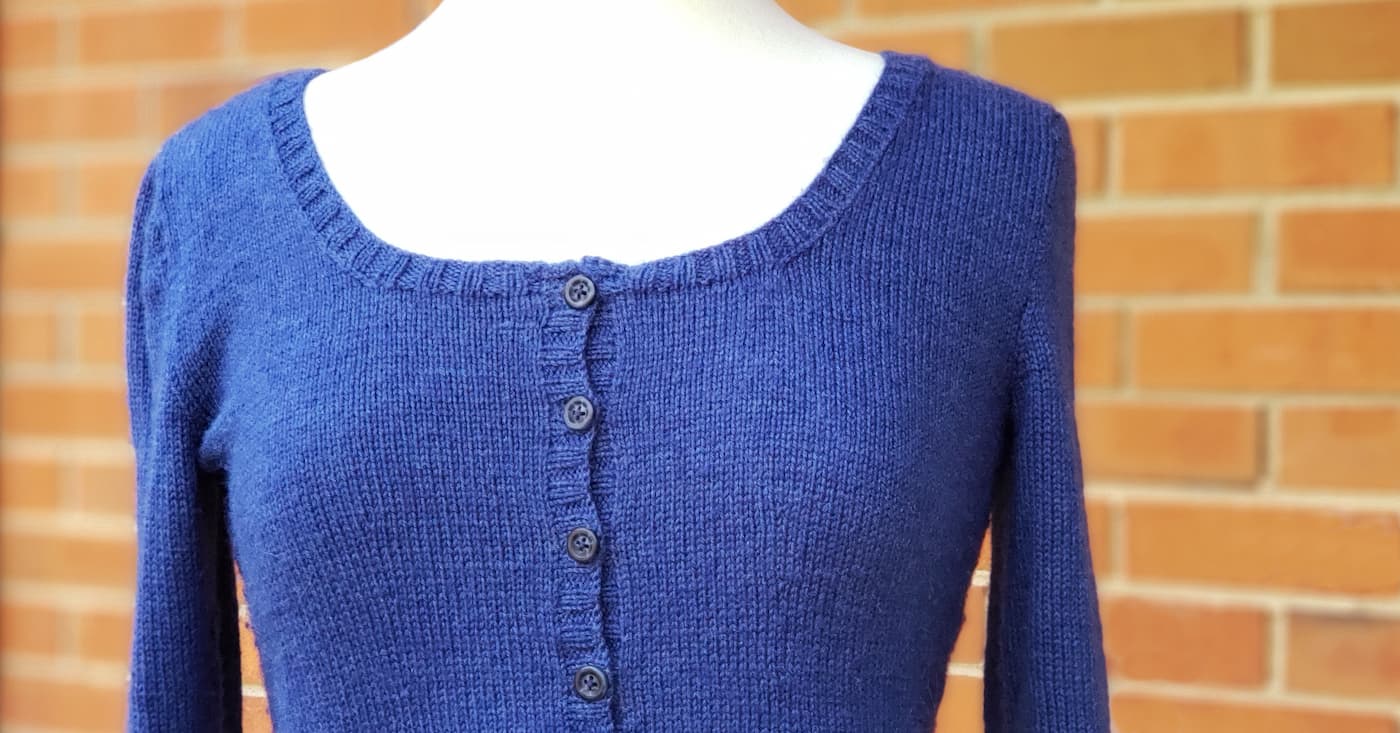
Finishing techniques are as important to a well-fitting, long-wearing sweater as the knitting itself. Have you ever knit a sweater that turned out great, but the neckline didn’t stretch quite enough to be comfortable? Or are you intimidated by seaming, so you only knit seamless sweaters?
The good news is that while it’s worth taking the time to do well, finishing your sweater doesn’t have to be impossibly hard. Here are my top 5 tips for getting the details right.
- Choose the right cast-on and bind-off. The best cast-on and bind-off for your project depends on 2 things: how firm or stretchy you need the edge to be, and how well it works with your stitch pattern. Obviously, the first point is the most important. You want edges like necklines and cuffs to stretch, but not stretch out of shape. Here are a few of my favorites:
- Alternate cable cast-on. This is a great cast-on for ribbing, especially 1×1 rib. It’s invisible like tubular cast-on, and stretches well, but isn’t quite as fiddly. I used this on a lot of my sweaters, such as the Campus Cardigan and the Composure Cardigan.
- Tubular bind-off is a nice match for the alternate cable-cast on and is also plenty stretchy for things like cuffs in top-down sweaters.
- Icelandic bind-off is somewhat stretchy, but holds its shape well, and a good match for garter stitch edges. I used this bind-off in my Chunky Gansey Cowl.
- Pick up stitches carefully. If your row gauge is significantly different from the pattern gauge, you may find that picking up the number of given in the pattern makes your button band pull in (too few stitches) or ripple (too many stitches). A good rule of thumb is to divide the stitch gauge by the row gauge and pick up stitches in that ratio – most commonly 2 stitches for every 3 rows, or 3 stitches for every 4 rows.
- Try a different seaming technique. Many knitters avoid seaming, but learning how to do it increases your options for patterns, and seams can help a sweater keep its shape longer, especially if it’s knit in a drapey yarn. The good news is there is more than one way to do it. If mattress stitch doesn’t work for you, try a different method such as backstitch.
- Buttonholes can be another sticking point for some knitters. In this case, too, there is more than one way. Some methods do work better for larger buttonholes, however, so it’s wise to learn a few different methods. My favorite is a one-row buttonhole.
- Weave in your ends carefully (or not!). Once again, there are several ways to do this, and there isn’t one ‘right’ method. The most important thing is to make sure you’re not adding too much bulk. If you have a thicker yarn, it can be helpful to split it and weave in two pieces separately to minimize the chance of it creating a bump in your garment. If you’re using a sticky yarn for colorwork, you may be able to just trim the ends and let them felt in – I won’t tell anyone!
What are your favorite finishing techniques?

Leave a Reply