
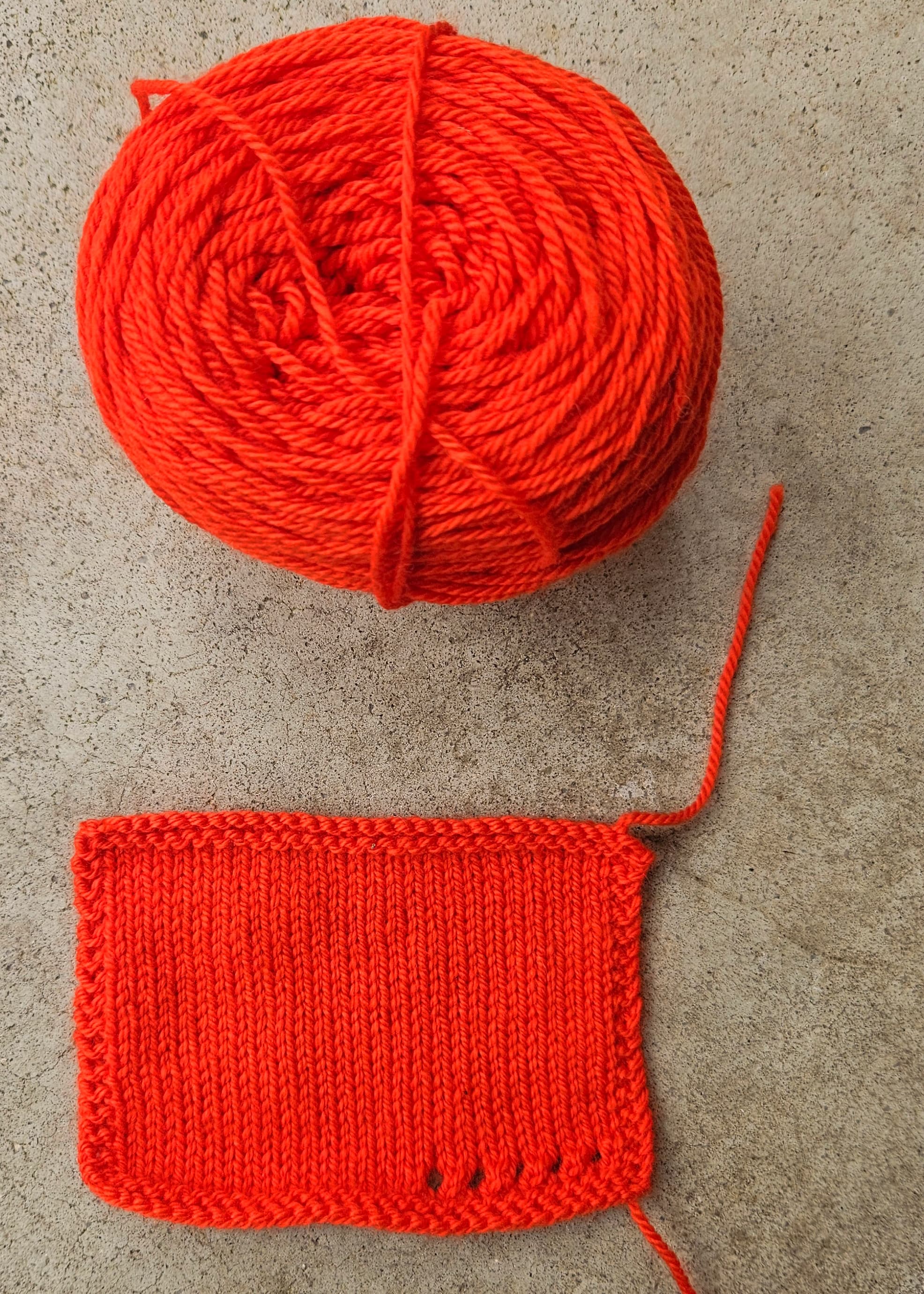
My interest is always piqued when I learn about new types of yarn, and especially innovations in sustainability. So when I learned about Knitpicks’ new ‘easywash’ wool yarn, Modish Merino, I had to try it out.
According to the Knitpicks website, the easywash process uses enzymes rather than chlorinated chemicals to smooth the wool’s surface – this makes it machine washable on a cool, delicate cycle. It claims the easywash process preserves “natural beauty and feel while reducing chemical waste.” I searched for more information on this process, but wasn’t able to find much information. I did find a claim that the easywash process is Oekotex, Bluesign, and REACH compliant.
I was curious to see how this yarn would behave compared to a standard superwash yarn.
Easywash vs. Superwash
Modish Merino (100% extra fine merino easywash; 256 yds/ 100g) is listed as a DK weight yarn, though for me it knit up closer to a sportweight. It comes in a range of 28 colors, with 10 tonal trios that can be paired to create gradients. I ordered a skein in the colorway Nasturtium, a bright orangy red shade. (Note: I purchased this skein myself; this is not a sponsored post.)
Right away I could tell a difference between the easywash yarn and a typical superwash yarn. The yarn is a bright, saturated color, but less shiny than standard superwash yarns typically are. The photo below shows the easywash yarn next to skeins of superwash and non-superwash merino – they easywash is somewhere between the two in terms of luster. It also has a somewhat cotton-y feel, which is what I would expect for a non-superwash fine wool like merino.

I like the bouncy feel of the yarn in the skein – superwash wool can often feel somewhat lifeless and heavy to me. It was pleasant to knit with and as soft as I would expect for a fine merino yarn.
Swatching Modish Merino
I cast on 30 stitches and knit a swatch on US #5 [3.75 mm] needles, and measured its dimensions before and after blocking. I blocked the swatch using my usual procedure – I soaked it in a tub of warm to hot water with a bit of wool wash for 20-30 minutes, then rolled in a towel and laid it flat to dry. I used pins at the corners only to prevent the edges from curling and was careful not to stretch the swatch.
My swatch measured 5 inches x 4 inches before blocking. After blocking it measured 5 1/8 inches x 4 inches. Unlike a typical superwash wool, it grew very little when soaked.
Washability
The instructions say to wash in a cool, delicate cycle. However, while I almost always hand wash my sweaters, I often throw items like socks and commercially made wool underthings in the washing machine with my regular load. I knit a second swatch and washed it on a short cycle on warm. As shown in the photo below, it became a bit fuzzy and every so slighted felted with this treatment. The new swatch measured 5 1/8 inches x 4 1/4 inches before washing, and 5 inches x 3 3/4 inches after.

I then washed my first swatch on a delicate cycle, following the instructions. This swatch too became very slightly fuzzy, but unlike the swatch washed on a regular cycle, it didn’t appear to felt. The stitches in the swatch remain defined, and the swatch softened up slightly into a nice, cohesive fabric, similar to the way woolen-spun yarns ‘bloom’ with washing. The swatch shrank by about 1/8-1/4 inch in length, measuring 5 inches by just over 3 3/4 inches after drying.
Playing Around
I also rubbed the swatch against itself to determine how likely it is to pill. A few pills began to form, but it stood up to rubbing fairly well. Softer yarns tend to come with a trade-off of managing pills, but I don’t expect that this would pill excessively.
Finally, to test stitch definition, I knitted a cabled swatch (this is the stitch pattern from the Rakaia Pullover from Farm and Fiber Knits). The yarn shows cables well – I can see working up this yarn into a cabled vest or pullover.

The Verdict
Overall, the modish merino is a solid merino yarn. I like that it feels ‘woolier’ than a standard superwash yarn, and I would knit a sweater in it. I especially like the color range. I wouldn’t necessarily use it for knits to gift to a friend or relative who doesn’t enjoy washing delicates, but I might use it for things like mittens that might benefit from an occasional machine washing. At $18.99 for a 100g skein, it is a bit more expensive than their Swish DK superwash as well (Swish comes in at $6.99 for a 50g skein).
Is easywash yarn worth the extra cost for a yarn I need to treat a bit delicately? Maybe. Since this is a relatively new process, I expect that improvements will be made over time. I would certainly consider trying other easywash yarns to see how they compare to this one.
Would you try it? Let me know your thoughts in the comments.
Leave a Reply